
Your customers aren’t just typing keywords into Google and scrolling through blue links. They’re asking ChatGPT which skincare brand is worth buying, Perplexity to recommend the best running shoes, getting direct, confident answers with no need to click through to your website at all. Welcome to 2026; where SEO alone is no longer enough.
What Is GEO, Exactly?
Generative Engine Optimization (GEO) is the practice of structuring your content, entity signals, and authority so that AI-powered search engines such as ChatGPT, Gemini, Perplexity, Claude, and Google AI Overviews may retrieve, trust, and cite your brand in generative answers.
Where traditional SEO asks “does Google rank this page?”, GEO asks “does the AI quote this page when a user asks a relevant question?”
GEO was formally defined in 2023-2024 by researchers at Princeton, Georgia Tech, and IIT Delhi. By early 2026, most enterprise marketing teams have a GEO initiative. Most SMB marketing teams have not started yet—which represents a significant first-mover opportunity.
SEO vs GEO: The Core Difference
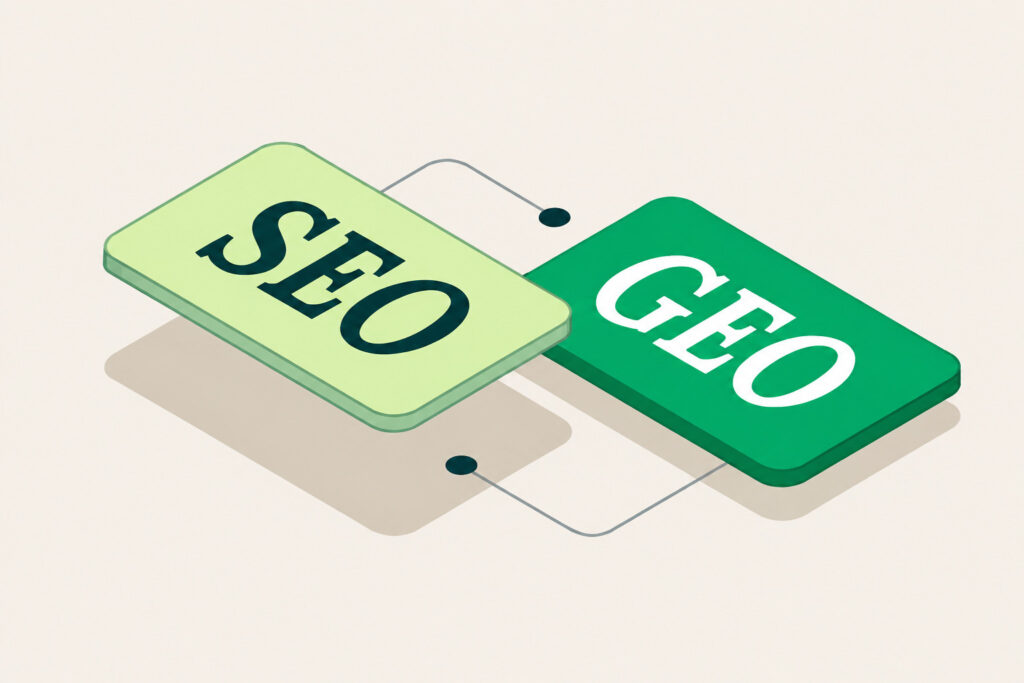
Search Engine Optimization (SEO) improves a website’s ranking on traditional search engines like Google and Bing. Generative Engine Optimization (GEO) increases the likelihood that AI platforms such as ChatGPT, Perplexity, Gemini, and Google AI Overviews will cite a brand, website, or content in their generated responses. SEO success depends on achieving high positions in search engine results pages and driving users to click through to a website. In contrast, GEO success comes from getting AI systems to reference, quote, or recommend a brand directly in their answers, even when users never visit the website.
SEO primarily relies on signals such as relevance, backlinks, technical crawlability, and domain authority, whereas GEO emphasizes content that is easily extractable by AI, clear, specific, well-structured, and supported by credible sources. Ultimately, SEO optimizes for search rankings and website traffic, while GEO optimizes for AI visibility and brand recognition within conversational search experiences.
Why SEO Still Matters
Let’s be clear: SEO isn’t dead. Google still sends far more referral traffic than every AI engine combined. A page that cannot get crawled or does not answer the query will not get cited by AI either.
Even Google itself has weighed in. In its official AI Search guide, Google states: *”From Google Search’s perspective, optimizing for generative AI search is optimizing for the search experience, and thus still SEO”*. GEO and AEO are treated as part of SEO, not separate disciplines.
The fundamentals haven’t changed: accessibility, discoverability, authority, and awareness remain the building blocks of both disciplines.
Why GEO Is No Longer Optional
Here’s why ignoring GEO in 2026 is a strategic error:
The numbers are staggering:
- ChatGPT now has over 800 million weekly active users
- Google Gemini has exceeded 750 million monthly users
- Google AI Overviews now appear in at least 16% of all searches
- AI search platforms sent 1.13 billion referral visits to websites in June 2025 alone; a 357% increase year over year
- 58% of users have already replaced traditional search engines with AI-driven tools for product and service discovery
The revenue impact:
- According to Gartner, traditional search volume will drop 25% by 2026 as conversational AI absorbs queries
- 35% of Gen Z now uses AI tools as their first stop for research questions
- AI-referred traffic converts at roughly 4 to 5 times the rate of standard organic search traffic
The bottom line? If your brand is not retrieved, trusted, and cited in those AI answers, you are invisible to a fast-growing share of demand.
Practical Steps to Win on Both Fronts in 2026
1. Build one plan for SEO and GEO
Decide which topics you want to own, then build one system behind them: one core message, one source-of-truth page, multiple formats that travel like articles, summaries, FAQs, and comparisons.
2. Structure for extraction, not just ranking
AI engines select passages, not pages. A page where the relevant answer is buried in paragraph eight loses to a page where the answer is in the first 60 words of a clearly structured section.
Use clear headers, short summaries, Q&A sections, comparison tables, definitions, and key takeaways.
3. Add statistics, citations, and quotations
A foundational study found that tactics like adding statistics, citing sources, and including quotations improved content visibility in AI-generated responses by up to 40%.
4. Refresh content regularly
GEO moves fast. AI rewards verified, updated, trustworthy brands. Refresh content every 4-6 weeks and expand topics AI already cites you for.
5. Track both rankings and citations
By mid-2026, every marketing team will track how often their brand appears in AI-generated answers, just as they track web traffic and search rankings today.
In conclusion, SEO and GEO are stronger together than either alone. The question isn’t whether to choose SEO or GEO. The question is whether your content strategy is built for a world where people discover information in two fundamentally different ways; through traditional search results and through AI-generated answers.
In 2026, the brands that win will be the ones that show up in both places. Not because they picked one strategy over the other, but because they built one unified approach that performs in two environments.
The game has changed. The question is: are you ready to play it?